Anyone with this link can load and play this session.
Before you share: anyone with the link can see this session's title, video/audio source, and loop settings — plus any notes/lyrics you choose to include via the toggle below. This is asked once.
On by default — uncheck to keep this session's notes/lyrics private.
Good for Shorts — the recipient lands straight in the fullscreen player instead of the normal page.
OR EMAIL IT DIRECTLY
EXPERT EDIT ACCESS
Share Practice List
Anyone with this link can view and play the songs in this list — no account needed. They can save individual songs as their own copy, but not the list.
🐛 Report a Bug
Tell us what went wrong — this goes straight to our support inbox.
🌟 Know an influencer? Are you one?
Influencers earn money while increasing their views. Tell us about the channels — we'll set them up for success.
📊 Referral Stats
✉️ Invited Friends
🎤 Influencer Flag
Grant or revoke report access for a user by email.
📊 Keyboard Session Log
🎤 Influencer Report
Views and saves across sessions you've shared.
Only counts plays from people signed in — anonymous/signed-out visitors aren't tracked yet. "Plays" counts each time the link was opened, not each loop replay within one visit.
➕ Add to Practice List
📥 Import YouTube Playlist
Paste a YouTube playlist link — every video becomes its own session, added to a new practice list.
▶ Tanpura
Select a tanpura drone to play alongside your session.
Create new practice
Name it, then type its notes — see the notation tip below.
Space-separated notes. S R G m P D N = shuddha (note: shuddha Ma
is lowercase m). r g M d n = komal Re/Ga, tivra Ma, komal
Dha/Ni. A leading dot = Mandra (.S), a trailing dot = Taar (S.).
Space-separated notes. Uppercase = natural (C D E F G A B). Add
# for a sharp (F#). Lowercase = flat (b = B-flat,
e = E-flat). A leading dot = one octave down (.C), a
trailing dot = one octave up (C.). These are fixed piano keys.
Use | as a bar/phrase separator — it shows in the notes strip
but is skipped when played. Use - to sustain the previous note
for one more duration instead of a new one.
Seconds per notes
🎵 Tap Tempo
Turn on the mic and tap along to the beat — we'll work out the BPM.
-- BPM
Clap at least 4 times for an accurate reading. Reduce speaker volume to track your claps accurately.
Beat anchor (locks click to the video)not set — using loop start
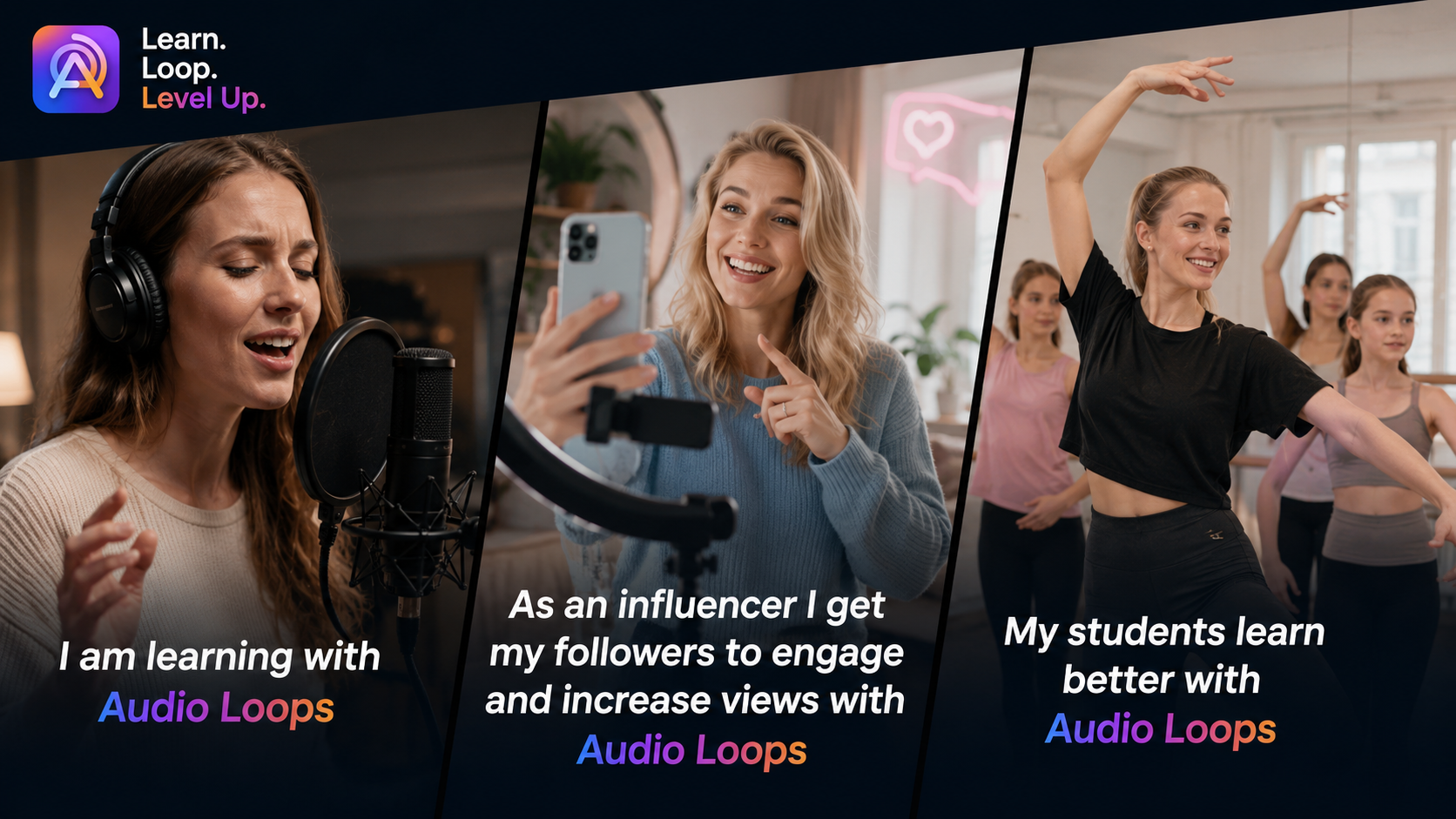
"I design practice sessions on any of my dance performance recordings for my students. They practice at their own pace. The app reports to me who completed how many sessions and loop counts. Perfect!"
"As a singer, I loop the hard riffs until they're second nature. The app is perfect for in-car practice. Total game changer. No distractions while driving and loops play on."
— Singer
🎸
"Slowing solos down without pitch-shifting means I can actually hear every note."
— Guitarist
🍳
"I like watching recipes while cooking, so being able to define loops that play automatically really helps me stay focussed on the actual cooking."
 Share This Practice